How to Pass the Goethe-Zertifikat B1: Format, Scoring, Study Plan
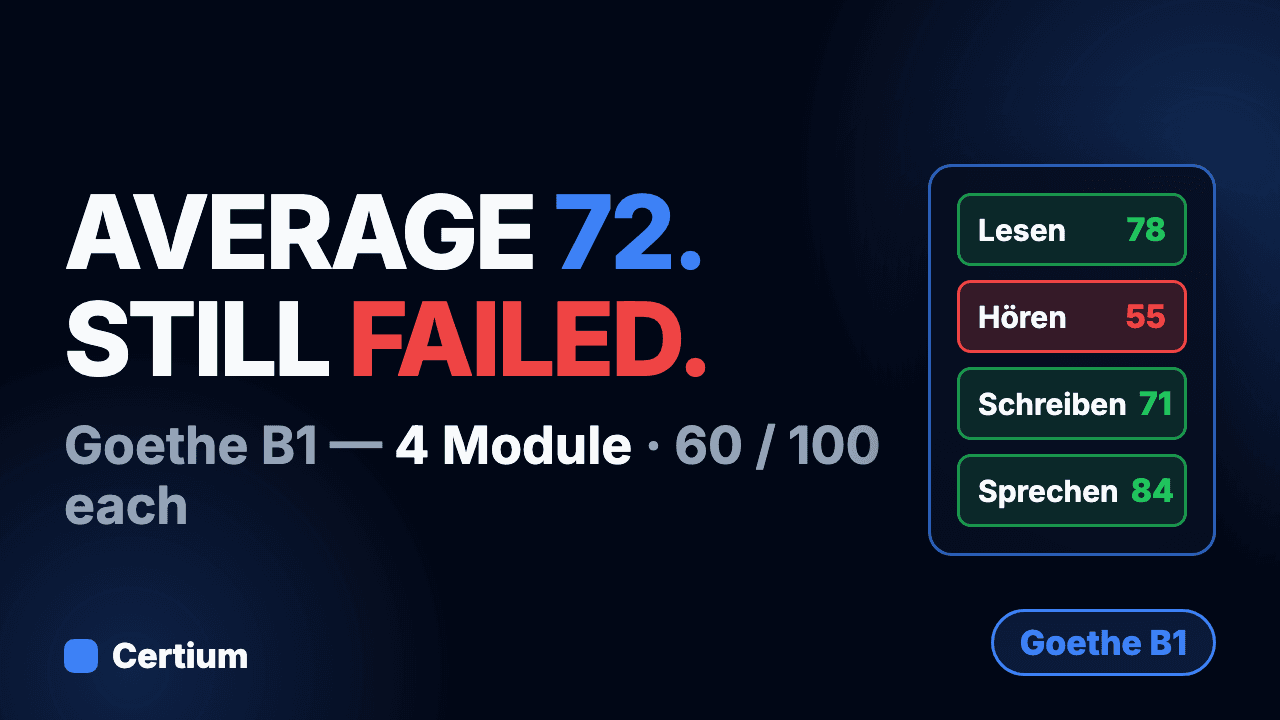
Passing the Goethe-Zertifikat B1 is less about perfect German and more about understanding a modular exam: four separate modules, each scored out of 100, each passed independently at 60 points. Once you know how the scoring works and what each module demands, you can prepare strategically instead of studying everything at once.
Updated 2026-10-02
Watch on YouTube
The four modules at a glance
| Module | Format | Time | Max points |
|---|---|---|---|
| Lesen (Reading) | 5 Teile — Richtig/Falsch, multiple choice, matching | 65 min | 100 |
| Hören (Listening) | 4 Teile — short clips, monologue, conversation, discussion | 40 min | 100 |
| Schreiben (Writing) | 3 Aufgaben — email, opinion post, short message | 60 min | 100 |
| Sprechen (Speaking) | 3 Teile — joint planning, presentation, discussion (paired) | ~15 min | 100 |
How scoring works — the modular system
Each module is scored out of 100 points, and you pass a module with at least 60 points (60%). The four modules are certified independently — this is the single most important fact about the Goethe B1 exam.
- ›You can pass some modules and retake only the ones you failed.
- ›A strong reading score cannot rescue a failing writing score — each module stands alone.
- ›Many exam centres let you sit modules on different dates.
What each module demands
Each module rewards different preparation. A quick orientation:
- ›Lesen: skim for gist, then scan for detail; manage 65 minutes across five short tasks.
- ›Hören: Teil 2 and Teil 3 are played only once — train one-pass listening.
- ›Schreiben: address every content point, use the right register, and stay near the target word counts (~80 / ~80 / ~40 words across the three tasks).
- ›Sprechen: a paired exam — practise reacting to a partner, not just delivering a monologue.
An 8-week study plan
- ›Weeks 1–2: Diagnose. Take one timed task of each module type to find your weakest skill.
- ›Weeks 3–5: Rotate focus — work on every module each week, with extra sessions for your weakest.
- ›Weeks 6–7: Full timed modules under exam conditions; review every mistake.
- ›Week 8: Light review, phrase banks for Schreiben and Sprechen, and rest before exam day.
Why candidates fail (and how to avoid it)
- ›Ignoring the single-listen Hören parts until exam day.
- ›Missing content points in Schreiben — re-read the prompt after writing.
- ›Running out of time in Lesen by over-reading the early tasks.
- ›Treating Sprechen as a solo speech instead of an interaction.
- ›Writing far over the word count, which wastes time without earning points.
Frequently asked questions
What score do you need to pass the Goethe B1 exam?
Each of the four modules is scored out of 100 points, and you need at least 60 points (60%) to pass that module. The modules are passed independently.
Can you retake just one module of Goethe B1?
Yes. The Goethe-Zertifikat B1 is modular, so you can keep the modules you passed and retake only the ones you failed.
How long is the Goethe B1 exam?
The three written modules take about 165 minutes in total (Lesen 65, Hören 40, Schreiben 60), plus a separate paired Sprechen exam of about 15 minutes.
How long does it take to prepare for Goethe B1?
It depends on your starting level, but candidates already around A2–B1 typically need 6–10 weeks of focused practice. Targeting your weakest module first is the fastest route to a pass.
Is Goethe B1 difficult?
It is a solid intermediate exam, but the modular 60% pass mark and predictable format make it very trainable. Most failures come from format surprises, not weak German.
Start practising
How to Pass the Goethe-Zertifikat B1