TELC B1 Sprachbausteine Explained: Parts 1 & 2
Sprachbausteine is a section unique to TELC exams that does not appear in Goethe. It tests grammar and vocabulary knowledge through two gap-fill (cloze) tasks. Many candidates find this section surprisingly tricky — not because the language is advanced, but because the answer options are close together and small grammatical differences decide the correct choice.
Updated 2026-07-11
Watch on YouTube
What is Sprachbausteine?
The word "Sprachbausteine" means "language building blocks." The section appears immediately after Lesen in the written exam and consists of two distinct parts: Teil 1 uses multiple-choice options, and Teil 2 uses a word bank. Together they test whether you can choose the grammatically and lexically correct word or phrase for a given context — skills that are essential for real-world German communication.
| Part | Format | Gaps | Suggested time |
|---|---|---|---|
| Teil 1 (Grammatik) | Multiple choice: choose from a, b, or c | 10 gaps | ~15 min |
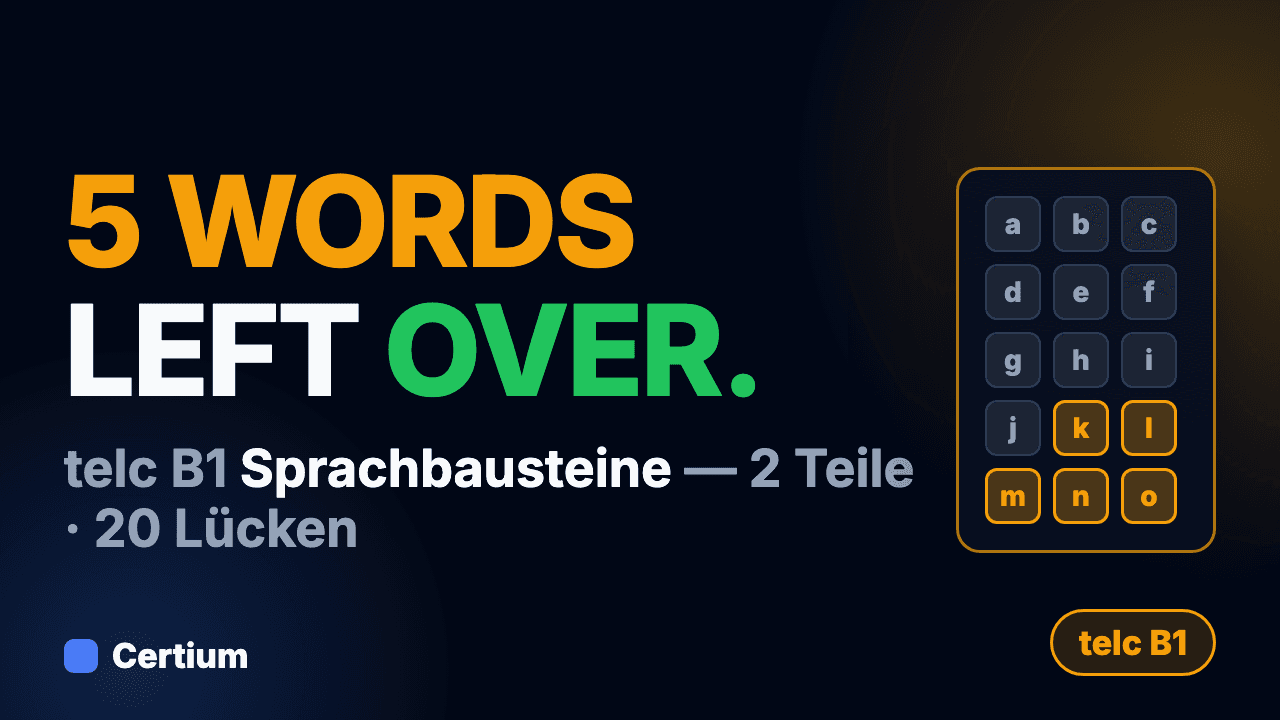
| Teil 2 (Lexik) | Word bank: 15 words (a–o) — 10 used, 5 distractors | 10 gaps | ~15 min |
Teil 1 — Grammatik (multiple choice cloze)
You receive a continuous text — usually a letter, article, or email — with 10 blanks. Each blank has three answer options (a, b, c). The options are typically grammatically similar forms: different cases, different prepositions, different verb forms, or different conjunctions.
Common grammatical structures tested include: prepositions with dative or accusative (in/an/auf/bei/mit/von), adjective endings (nominative, accusative, dative), verb forms (present, past, subjunctive II for polite requests), and connectors (obwohl, damit, weil, wenn, als).
- ›Read the whole text once before looking at answer options — context resolves many ambiguities.
- ›For prepositions, ask: does this verb / adjective / noun require a fixed preposition?
- ›For verb forms, check: is this direct speech, reported speech, or a wenn-clause?
- ›For adjective endings, identify the gender, case, and whether you're using ein- or definite article.
- ›If two options look equally plausible, re-read the surrounding sentence for a subtle grammatical clue.
Teil 2 — Lexik (word bank)
A second, shorter text has 10 blanks. You are given 15 words in a box (labelled a–o). Exactly 10 words fit the blanks; the other 5 are distractors. Each word can only be used once.
The words are mostly everyday vocabulary: common verbs, prepositions, conjunctions, and adverbs. The test is not about knowing rare words — it is about precision. Knowing that "aufhören" and "anfangen" are antonyms, or that "seitdem" requires a past context while "seither" is formal, makes the difference.
- ›Read the text fully before filling any gap.
- ›Fill the blanks you are certain about first, crossing each used word off the list.
- ›For the remaining gaps, use the process of elimination: which words are left and do they fit?
- ›Watch for grammatical constraints: if the gap needs a verb in infinitive form, eliminate past-tense forms.
- ›Check collocations: certain verbs always go with specific prepositions (sich freuen auf, bestehen aus, etc.).
Common mistakes and how to avoid them
- ›Choosing by "feel" without checking grammar: always verify case and preposition requirements systematically.
- ›Using the same word twice in Teil 2: each word can only appear once — cross it off when you place it.
- ›Rushing Teil 1 and running out of time for Teil 2: plan roughly 15 minutes per part, about 30 minutes in total.
- ›Ignoring punctuation: commas before relative clauses and "weil/dass/ob" clauses can indicate which conjunction is needed.
- ›Not re-reading the completed sentence: after inserting your answer, read the full sentence aloud (in your head) to check it flows naturally.
Grammar areas most often tested
- ›Two-way prepositions (an, auf, in, über, unter, vor, hinter, neben, zwischen) with accusative for motion and dative for location.
- ›Modal verbs (müssen, dürfen, sollen, wollen, können, mögen/möchten) in present and Konjunktiv II.
- ›Relative clauses: the relative pronoun agrees in gender/number with its antecedent but takes the case required by the relative clause.
- ›Adjective endings with definite article (der, die, das), indefinite article (ein, eine, ein), and no article.
- ›Connectors: coordinating (und, aber, oder, denn, sondern) vs. subordinating (weil, dass, wenn, obwohl, damit).
- ›Reflexive verbs and fixed prepositional phrases (sich interessieren für, warten auf, etc.).
How to prepare
- ›Work through at least three complete TELC B1 Modellsätze — Sprachbausteine appears in every one.
- ›Review the 40 most common German prepositions with fixed cases and verb collocations.
- ›Practise adjective endings using a table and drilling with flashcards.
- ›Cloze tests from any B1 grammar workbook train the pattern-matching reflex needed for Teil 1.
- ›Write short texts yourself using conjunctions consciously — this builds the intuition that makes Teil 1 faster.
Start practising
TELC B1 Sprachbausteine Explained