How to Pass telc Deutsch B1: Format, Scoring, and Study Plan
telc Deutsch B1 differs from Goethe B1 in one decisive way: it is scored as a whole, not as separate modules. You need 60% of the written part and 60% of the oral part — and you cannot use a strong written score to rescue a weak oral one. Understanding that scoring logic shapes how you should prepare.
Updated 2026-05-24
Watch on YouTube
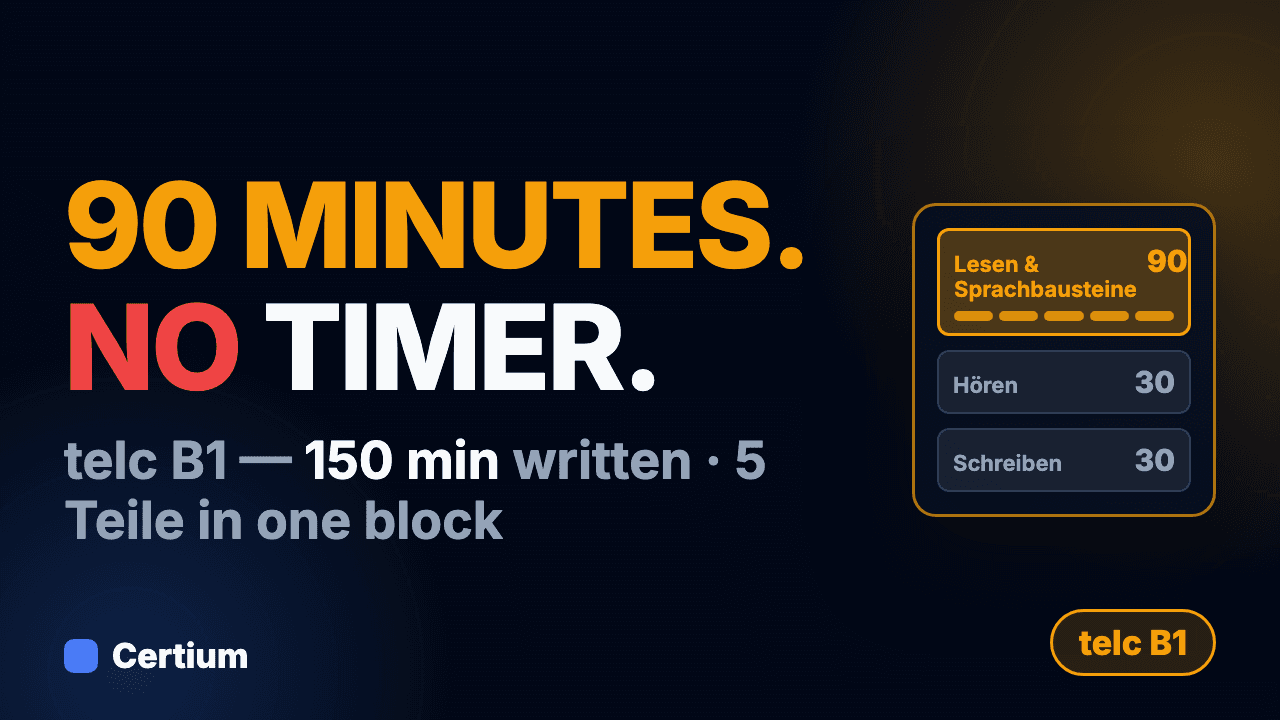
Exam structure
| Part | Sections | Time |
|---|---|---|
| Lesen & Sprachbausteine | 3 reading parts + 2 language-element parts | 90 min (you divide it) |
| Hörverstehen | 3 Teile (Global, Detail, Selektiv) | 30 min |
| Schriftlicher Ausdruck | 1 guided letter/email (4 Leitpunkte) | 30 min |
| Mündliche Prüfung | 3 Teile — contact, topic, joint planning (paired) | ~15 min |
How scoring works — written and oral, separately
telc B1 is scored out of 300 points: 225 for the written exam and 75 for the oral exam. To pass, you must reach at least 60% of each part independently.
- ›Written: at least 135 of 225 points (60%).
- ›Oral: at least 45 of 75 points (60%).
- ›You cannot compensate a failing oral score with an excellent written score, or vice versa.
What each part demands
- ›Lesen & Sprachbausteine: the Sprachbausteine cloze tests grammar and vocabulary precisely — budget time so it does not eat your reading minutes.
- ›Hörverstehen: Teil 1 is played only once; the rest play twice. Answers are binary (Richtig/Falsch).
- ›Schriftlicher Ausdruck: you must address all four Leitpunkte (guideline points) for full marks.
- ›Mündliche Prüfung: a paired exam — contact, topic discussion, and joint planning, with preparation time beforehand.
Study plan
- ›Weeks 1–2: Learn each part's format; take one timed section of each.
- ›Week 3: Drill Sprachbausteine and the single-listen Hören Teil 1 — common weak spots.
- ›Week 4: Full timed written exam (150 min) plus a recorded speaking run-through.
- ›Throughout: Build a phrase bank for the letter and the speaking tasks.
telc or Goethe?
Both certify the same B1 level, but the formats differ — telc is scored as a whole and includes Sprachbausteine, while Goethe is modular. If you can choose, pick the format that matches your strengths; if an institution requires one specifically, prepare for that exam's exact tasks.
Frequently asked questions
What score do you need to pass telc B1?
You need at least 60% of the written part (135 of 225 points) and 60% of the oral part (45 of 75 points), for 300 points total. Both parts must be passed independently.
Can a strong written score make up for a weak speaking score in telc B1?
No. The written and oral parts are assessed separately, and you must reach 60% in each. One cannot compensate for the other.
How long is the telc B1 exam?
The written exam is 150 minutes (90 for reading and language elements, 30 for listening, 30 for writing), plus a paired oral exam of about 15 minutes.
What is Sprachbausteine in telc B1?
Sprachbausteine is a language-elements section unique to telc: two cloze tasks of 10 gaps each — one multiple-choice (grammar) and one wordbank (vocabulary). Goethe B1 has no direct equivalent.
Is telc B1 easier than Goethe B1?
Neither is reliably easier — they test the same B1 level in different formats. telc adds Sprachbausteine and scores the whole exam at once; Goethe is modular. Choose based on your strengths or the certificate your institution accepts.
Start practising
How to Pass telc Deutsch B1