TELC B1 Hörverstehen: Format, 3 Teile, and Practice Tips
telc B1 Hörverstehen is short — about 30 minutes — but dense. The whole first part is played only once, and almost every question is a binary Richtig/Falsch decision where a single misheard detail flips the answer. Knowing the three Teile and their playback rules lets you spend your attention where it counts.
Updated 2026-10-02
Watch on YouTube
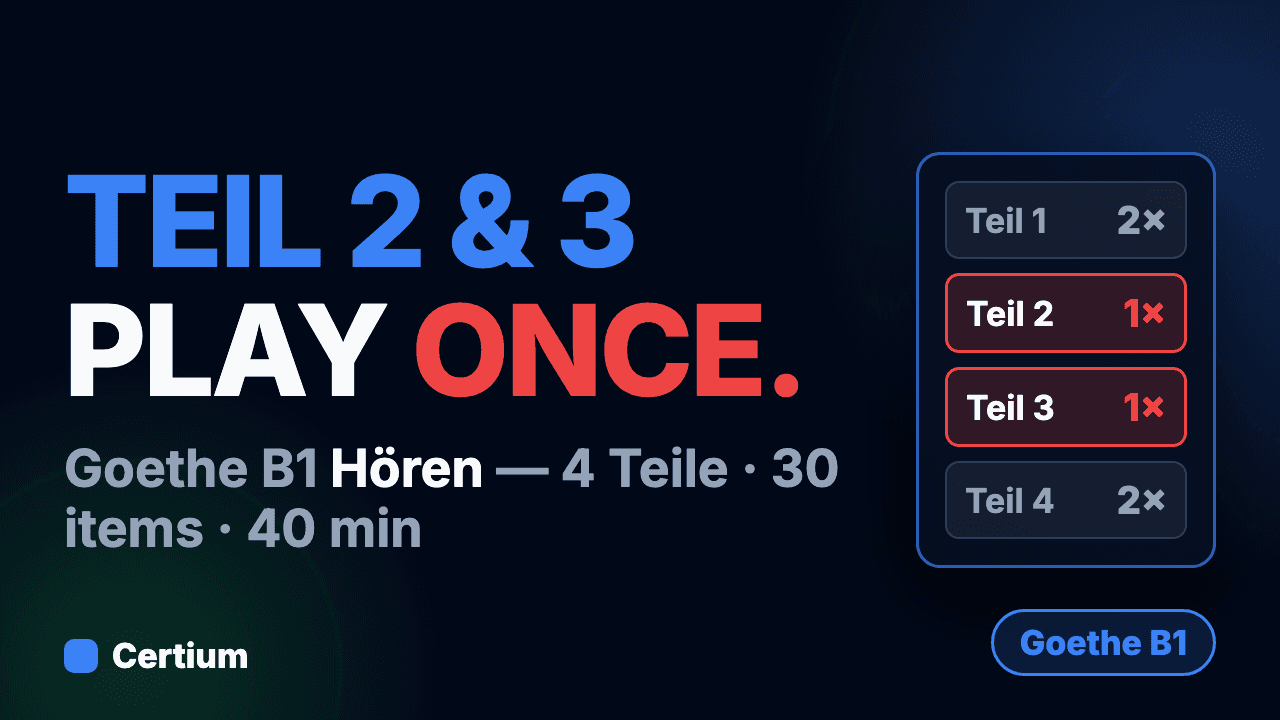
Module overview
| Teil | Focus | Items | Listens | Time |
|---|---|---|---|---|
| Teil 1 — Globalverstehen | Main point of each clip | 5 (Richtig/Falsch) | 1× | ~10 min |
| Teil 2 — Detailverstehen | Details of one longer audio | 10 (Richtig/Falsch) | 2× | ~10 min |
| Teil 3 — Selektivverstehen | One specific fact per clip | 5 (Richtig/Falsch) | 2× | ~10 min |
Teil 1 — Globalverstehen (single listen)
Five short, independent clips — announcements, messages, short reports. For each, you decide whether one statement about the main idea is Richtig or Falsch. You hear each clip only once.
- ›Focus on the gist, not the detail — this part tests whether you caught the main point.
- ›Read the statement before the clip plays so you know what to verify.
- ›Decide and commit; there is no second listen to fall back on.
Teil 2 — Detailverstehen
One longer audio — an interview or conversation — with ten Richtig/Falsch statements about specific details. You hear it twice.
- ›The ten statements follow the order of the audio; track your position.
- ›First listen for the overall flow, second to confirm each detail.
- ›A statement is Falsch if any part of it contradicts the audio.
Teil 3 — Selektivverstehen
Five short clips again, each requiring you to extract one specific piece of information and judge a Richtig/Falsch statement. You hear each clip twice.
- ›You are listening for one targeted fact — ignore the surrounding filler.
- ›Pre-read the statement so you know exactly which detail matters.
Richtig / Falsch strategy
Almost every telc B1 listening item is a binary decision. That is good news: even an uncertain answer has a 50% chance, so never leave a blank.
- ›Beware paraphrase traps: the audio rarely uses the same words as the statement.
- ›Negations flip everything — "kein", "nicht", and "nie" change the correct answer.
- ›When unsure, decide on the main meaning rather than a single word you think you heard.
Practice plan
- ›Weeks 1–2: One Teil per day; learn each format and the binary answer style.
- ›Week 3: Drill Teil 1 under single-listen conditions — it is the only one-pass part.
- ›Week 4: Full 30-minute timed Hörverstehen sections.
- ›Throughout: Re-listen with the transcript to learn which paraphrases tricked you.
Frequently asked questions
How many parts does telc B1 Hörverstehen have?
Three: Teil 1 (Globalverstehen, 5 items), Teil 2 (Detailverstehen, 10 items), and Teil 3 (Selektivverstehen, 5 items) — 20 items in about 30 minutes.
How many times is each audio played in telc B1 listening?
Teil 1 is played only once. Teil 2 and Teil 3 are each played twice. The single-listen Teil 1 is the part to train hardest.
How is telc B1 listening scored?
Hörverstehen is part of the written exam, which is worth 225 of the 300 total points. You need at least 60% of the written part (135 points) and 60% of the oral part to pass.
Why are telc answers sometimes Ja/Nein or Plus/Minus instead of Richtig/Falsch?
They are the same binary format with different labels. telc practice materials use Richtig/Falsch, Ja/Nein, and Plus/Minus interchangeably; you always choose between two options.
Start practising
TELC B1 Hörverstehen